Splice donor — downstream intronic variant
This example demonstrates how a splice-adjacent intronic HGVS variant is represented using RelativeAllele. The variant occurs immediately downstream of a splice donor site and is expressed using HGVS c. notation.
HGVS expression
We will use the following HGVS expression from ClinVar: NM_001385641.1(SAMD11):c.609+13G>A.
This expression specifies a single-nucleotide variant located downstream of the coding exon boundary, placing the variant in the intron adjacent to a splice donor site.
Transcript context
NCBI Reference Sequence: NM_001034954.3
Positive strand
Splice donor (exon → intron boundary)
Downstream intronic (intron side of the exon boundary)
Transcript features at the splice junction
The exon boundaries below provide the local transcript context used to interpret the splice-adjacent HGVS position and to identify the exon boundary referenced by the HGVS expression.
CDS            510..3044
exon 2         1027..1118
                    /gene="SAMD11"
exon 3         1119..1300
                    /gene="SAMD11"
NCBI graphical sequence view
The figure below shows the same region in the NCBI Sequence Viewer, which displays transcript structure and exon boundaries aligned to the reference sequence.
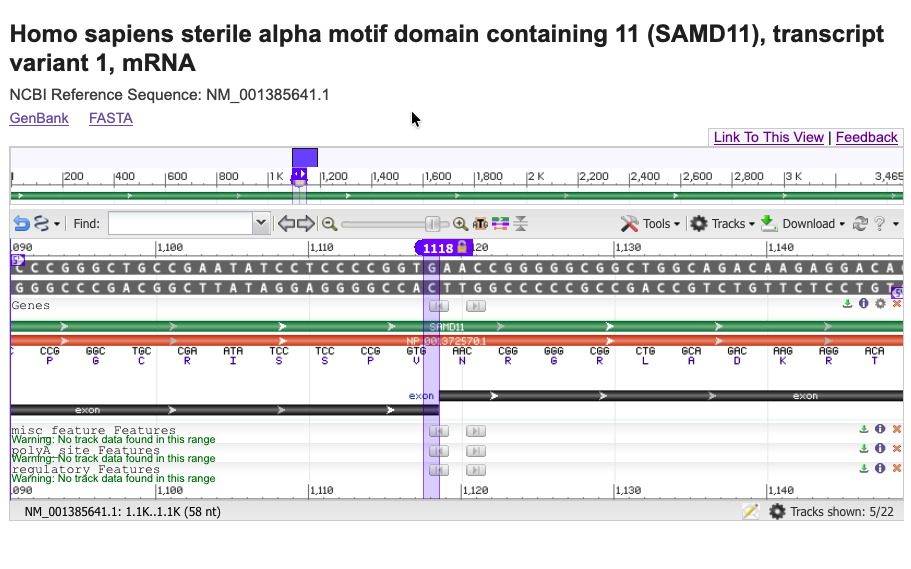
NCBI Sequence Viewer showing the splice donor region in NM_001385641.1
Anchor selection
To represent this variant, an anchor is chosen at the inter-residue position corresponding to the exon boundary referenced by the HGVS expression. For splice-donor variants, this anchor is placed at the end of the exon preceding the intron.
Anchor selection is determined by splice context and does not depend on transcript orientation. In this example, the exon end occurs at inter-residue position 1118, which is used as the anchor.
The diagram below illustrates the selected anchor position relative to the exon boundary.

Mapping relative to the anchor
Offsets are applied relative to the anchor to identify the transcript-relative inter-residue interval corresponding to the HGVS position.
Because the anchor represents the point at which an alignment gap occurs (e.g. an exon junction mapped to two sides of an intronic sequence), anchorOrientation is used to select which side of the anchor is used as the reference point. For this splice-donor variant, the anchor is oriented to the left, selecting the side of the anchor immediately preceding the exon-intron boundary.
Offsets are expressed in inter-residue coordinates. In this example, offsetStart = 12 and offsetEnd = 13 select the single inter-residue interval downstream of the exon boundary, corresponding to the nucleotide referenced by the HGVS expression.
Transcript orientation is then used to map this inter-residue interval to the genomic reference.
In this example, the variant is described relative to the transcript reference sequence (NM_001385641.1), where the reference base at the variant position is G.
The variant state is therefore shown on the transcript as the mapped state (G → A), and on the corresponding genomic reference (NC_000011.10) as the base state (G → A). Because this transcript is on the positive strand, the mapped and base states are identical.
The diagram below illustrates the application of offsets relative to the anchor, the resolved inter-residue interval, and the relationship between the mapped and base states.

The corresponding exon boundaries on the genomic reference are shown below for visual confirmation.


Relative Allele representation
Together, the anchor position and offsets resolve the location of the variant, which can then be represented as a VRS RelativeAllele. The resulting object captures the transcript-relative mapping, the resolved genomic location, and the allele state expressed on both sequences.
{
  "type": "RelativeAllele",
  "relativeLocation": {
    "baseSequenceLocation": {
      "type": "SequenceLocation",
      "sequenceReference": {
        "type": "SequenceReference",
        "id": "NC_000011.10",
        "refgetAccession": "SQ.2NkFm8HK88MqeNkCgj78KidCAXgnsfV1"
      },
      "start": 926025,
      "end": 926026
    },
    "mappedSequenceLocation": {
      "sequenceReference": {
        "type": "SequenceReference",
        "id": "NM_001385641.1",
        "refgetAccession": "SQ.cXRaN1IhgR6Mg9U-qafH2Be6IuQgB6Ox"
      },
      "anchor": 1118,
      "anchorOrientation": "left",
      "offsetStart": 12,
      "offsetEnd": 13
    }
  },
  "mappedState": {
    "type": "LiteralSequenceExpression",
    "sequence": "A"
  },
  "baseState": {
    "type": "LiteralSequenceExpression",
    "sequence": "A"
  }
}